Veröffentlichungsdatum: 18. August 2026. Autor des Artikels: Rooturaj Pattanaik
FRANKFURT — Europe’s most vital inland waterway has hit depths not seen in modern history. As global logistics networks face unprecedented volatility, staying updated with Global Transport & Logistics News becomes crucial for supply chain leaders navigating European trade disruptions. According to data from Germany’s Waterways and Shipping Administration (WSV), the official water level gauge at the critical Kaub bottleneck near Koblenz fell to a staggering 6 cm in mid-August 2026. This smashes the previous record low of 25 cm set in 2018, effectively severing commercial navigation through the Rhine’s narrowest channel.
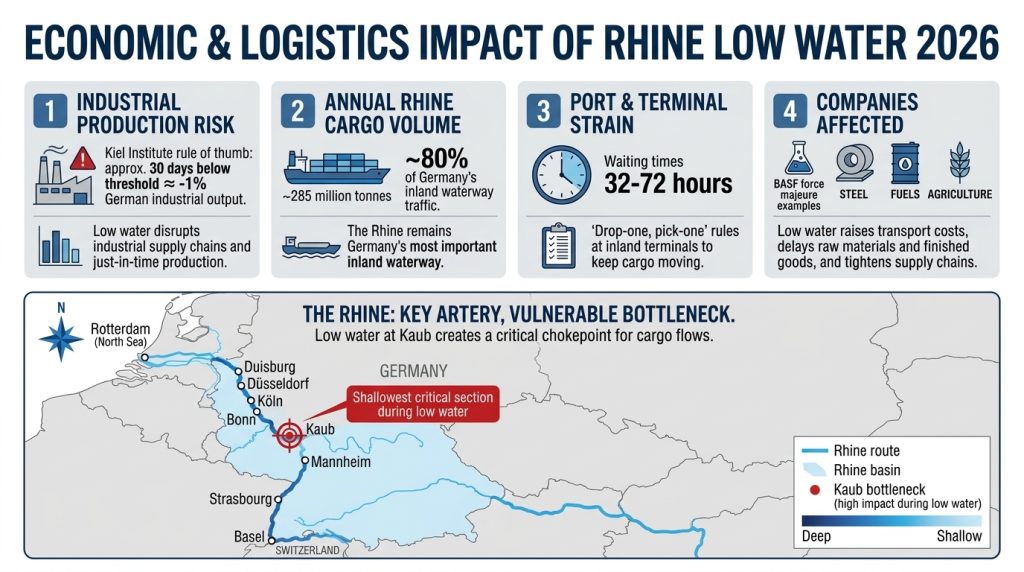
While the physical river channel remains roughly one metre deeper than the gauge reading, the available depth is entirely insufficient for standard commercial barges. Levels at Kaub have now remained below the critical 78 cm threshold since mid-July. According to economic models from the Kiel Institute for the World Economy (IfW Kiel), 30 consecutive days below this mark historically reduces German industrial production by roughly 1% — a threshold that has now been crossed for the third time in less than a decade.
1. Freight Dynamics & Logistics Rerouting
The Rhine normally transports around 285 million tonnes of cargo annually, representing roughly 80% of Germany’s inland waterway freight. It connects the deep-sea hubs of Rotterdam, Amsterdam, and Antwerp (ARA ports) with the industrial heartlands of Germany, France, and Switzerland.
Bildquelle: https://transportchronicle.com/rhine-river-plunges-to-historic-lows-forcing-europes-key-trade-artery-onto-roads-and-rails/
The Payload Capacity Collapse
With water levels dropping to historic lows, shipping operators have been forced to drastically reduce vessel loads:
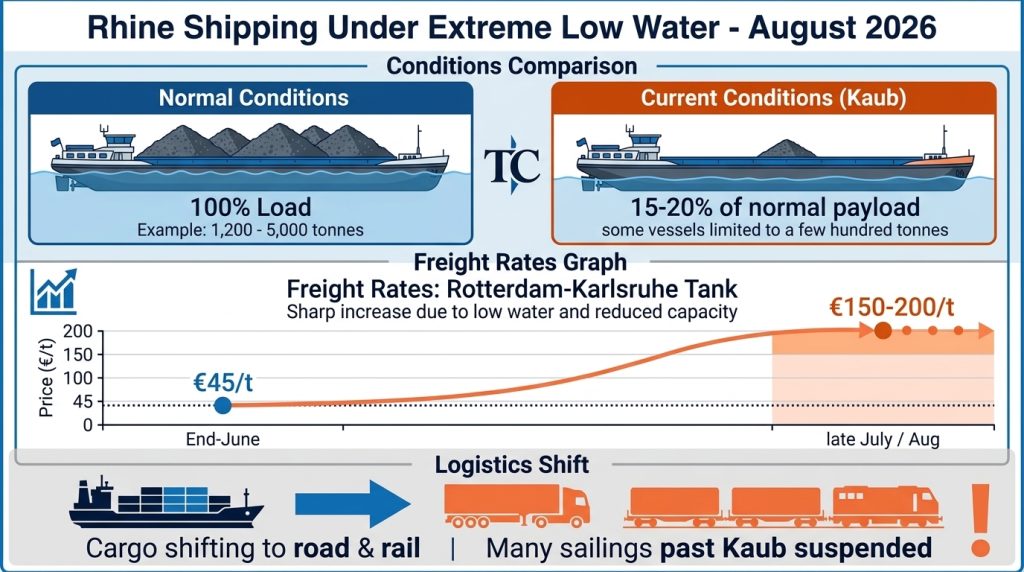
- Payload Restrictions: Vessels are operating at just 15%–20% of normal capacity. A standard 1,200-tonne tanker barge is restricted to carrying a few hundred tonnes, while large 5,000-tonne capacity vessels can transport no more than 1,200 tonnes.
- Freight Rate Surge: Spot freight rates on the key Rotterdam-to-Karlsruhe route shot up from €45 per tonne in late June to between €150 and €200 per tonne by August.
- Terminal Congestion: Rail and trucking lines are absorbing as much displaced volume as possible, but overland networks face acute capacity limits. Inland container terminals have introduced „drop-one, pick-one“ rules to manage yard density, while waiting times for barges at ARA ports have reached up to 72 hours.
2. Economic & Sectoral Vulnerabilities
The disruption extends far beyond transport logistics, causing cascading delays and cost spikes across Europe’s industrial core.
Cross-Industry Impact Analysis
| Industry Sector | Primary Freight Impact | Vulnerability & Downstream Effects |
|---|---|---|
| Chemicals | Raw material supply (naphtha, basic chemicals) | High risk of supply disruption. BASF has declared force majeure on key surfactant lines due to precursor shortages. |
| Energy & Utilities | Coal, refined diesel, heating oil | Coal-fired power stations in Baden-Württemberg and Bavaria face depleted reserves; fuel stations experience regional price spikes. |
| Steel & Metals | Iron ore, coking coal, scrap metal | Steelmakers in Duisburg and Saarland face production throttling due to delayed heavy raw material shipments. |
| Agriculture | Grain, oilseeds, fertilizers | Peak harvest season coincides with severe delays in fertilizer distribution and grain exports from inland silos. |
3. Structural Infrastructure & Technological Adaptation
Because low-water events are no longer isolated incidents (occurring in 2018, 2022, and now 2026), European industry is moving toward structural solutions to build long-term resilience.
Waterway Engineering: The Mittelrhein Project
Germany’s Federal Ministry of Transport has prioritized the deepening of the Middle Rhine (Mittelrhein). The project aims to increase the minimum draft depth between Wiesbaden and Koblenz (including Kaub) from 1.90 m to 2.10 m. Once completed, this engineering effort will allow barges to carry 20–30% more cargo during low-water periods. However, regulatory procedures and environmental impact assessments mean full implementation is not expected before the late 2020s.
Fleet Innovation: Low-Draft Vessels (Flachwasser-Schiffe)
Industrial giants are redesigning their river fleets:
- Shallow-Draft Tankers: Chemical manufacturers have partnered with barge operators to engineer specialized vessels (such as the Stolt Ludwigshafen). These barges feature lightweight materials, wider beam designs, and distributed load mechanisms that allow them to carry up to 800 tonnes even at critical gauge levels of 30 cm.
- Digital Gauge Forecasting: Real-time hydro-predictive AI models now allow logistics planners to optimize load factors 7 to 10 days before departure, preventing vessels from stranding mid-voyage.
4. Modal Interchange Realities: The Capacity Gap
A common assumption during river crises is that rail and road freight can seamlessly replace water transport. However, modal capacity limits present a physical bottleneck:
1 Standard Rhine Barge (2,500 tonnes)≈75–100 Heavy Trucks (TIR)
1 Standard Rhine Barge (2,500 tonnes)≈2–3 Full Freight Trains
To fully replace the daily cargo volume moving through Kaub, European logistics networks would need to add thousands of daily truck journeys and hundreds of additional rail slots to an already congested infrastructure.
Bildquelle: https://transportchronicle.com/rhine-river-plunges-to-historic-lows-forcing-europes-key-trade-artery-onto-roads-and-rails/
5. Strategic Takeaways for Supply Chain Leaders
To mitigate the impact of future Rhine low-water episodes, logistics managers should consider the following proactive measures:
- Contractual Low-Draft Fleet Guarantees: Secure long-term charters for shallow-draft barges rather than relying exclusively on spot market capacity during dry months.
- Seasonal Inventory Buffering: Build up raw material reserves at southern German and Swiss facilities prior to the July–October seasonal low-water window.
- Pre-Booked Multimodal Corridors: Establish flexible „barge-to-rail“ contracts with inland hubs (such as Duisburg or Mannheim) that activate automatically when gauge levels drop below 78 cm.
- Alternative Water Routes: Explore secondary waterways (e.g., Danube, canals) and port diversions (Hamburg, Bremerhaven, Marseille) for specific cargo flows.
Bildquelle: https://transportchronicle.com/rhine-river-plunges-to-historic-lows-forcing-europes-key-trade-artery-onto-roads-and-rails/